

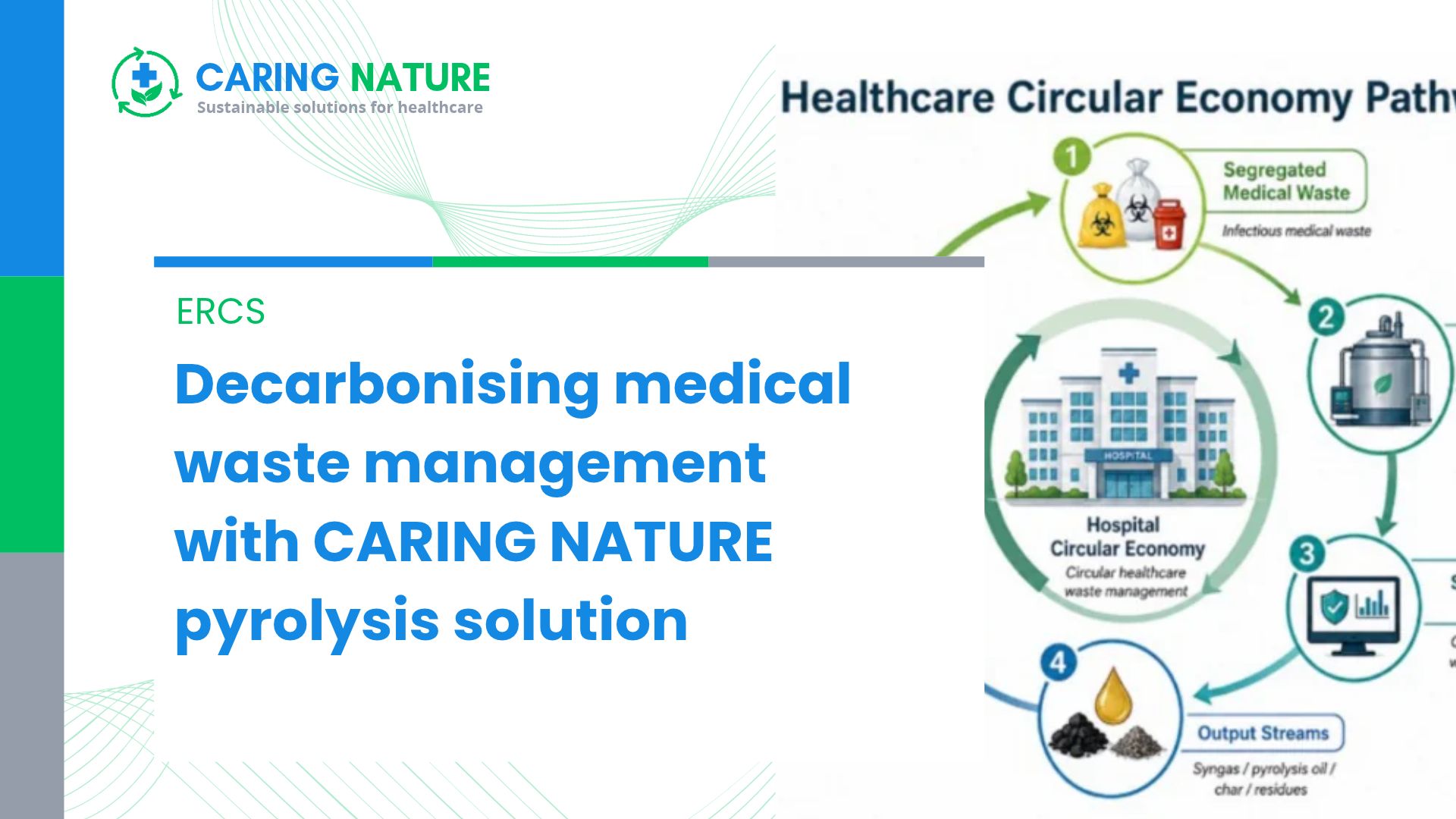
How can hospitals reduce the environmental impact of infectious medical waste while improving operational efficiency? A new article published in Open Access Government highlights how CARING NATURE partner Environmental Research Consulting Services (ERCS) is addressing this challenge through an innovative on-site pyrolysis solution.
Hospitals generate significant quantities of infectious and hazardous waste, traditionally collected, transported and treated in external facilities, often through high-temperature incineration. While essential for ensuring safety, these processes contribute to greenhouse gas emissions, transportation costs and resource consumption.
Through the EU-funded CARING NATURE project, Environmental Research Consulting Services (ERCS) has developed and tested an innovative modular low-temperature pyrolysis system designed to treat infectious medical waste directly within healthcare facilities.
The technology uses thermal treatment in an oxygen-limited environment to significantly reduce waste mass and volume while generating potential recoverable resources, including combustible gas, pyrolysis oil and solid residues. By enabling local treatment, the solution aims to reduce dependence on external waste management infrastructure and support more circular healthcare practices.
Promising environmental and economic results
As presented by Thanasis Demosthenous from ERCS in the article Decarbonising Medical Waste Management, the solution has undergone technical testing and feasibility assessments across different European healthcare environments.
The findings highlight significant potential benefits:
- 68% reduction in waste management-related CO₂ emissions: In a large Southern European university hospital case, the proposed on-site pyrolysis scenario could avoid approximately 1,005 tonnes of CO₂ equivalent annually compared with conventional off-site treatment.
- Up to 90% reduction in waste mass: The technology could substantially decrease the amount of material requiring final disposal.
- An estimated six-month investment payback period: Economic modelling indicates that operational savings could justify the investment even without accounting for potential revenues from recovered resources.
These results are based on feasibility assessments and demonstrate the potential of the technology rather than emissions reductions already achieved through full-scale deployment. The analysis also highlights that environmental and economic benefits depend on each healthcare facility’s waste volumes, existing treatment arrangements, infrastructure and regulatory conditions.
From research to market-ready innovation
Beyond its promising environmental performance, the solution represents an important technological achievement for CARING NATURE.
ERCS has successfully designed, built and tested a modular pyrolysis prototype, combining automated process control, continuous monitoring and a flexible architecture that can be adapted to different healthcare facilities.
The innovation has also received recognition from the European Commission’s Innovation Radar, which classified the technology as Market Ready and identified ERCS as a Key Innovator.
This recognition highlights the solution’s technological maturity and commercial potential, paving the way for further collaboration with hospitals, public authorities and industrial partners.
Supporting the transition towards circular healthcare
ERCS’s work illustrates how innovative waste treatment technologies can contribute to the broader objectives of CARING NATURE: reducing the environmental footprint of healthcare organisations while supporting more efficient and sustainable operations.
Although on-site pyrolysis still requires appropriate safety controls, environmental monitoring and regulatory approvals, it offers a promising alternative to conventional waste management pathways.
By combining waste reduction, lower transport dependency and opportunities for controlled energy and resource recovery, the solution demonstrates how healthcare organisations can move towards more circular, resource-efficient and lower-carbon waste management systems.
The next step will be to explore deployment opportunities in suitable healthcare settings, building on the technical, environmental and economic evidence developed through CARING NATURE.
Read the full article, written by Thanasis Demosthenous (ERCS) and published in Open Access Government:
Decarbonising medical waste management – Open Access Government



 This project has received funding from the European Union’s Horizon Europe research and innovation action programme under the grant agreement n°101137340.