

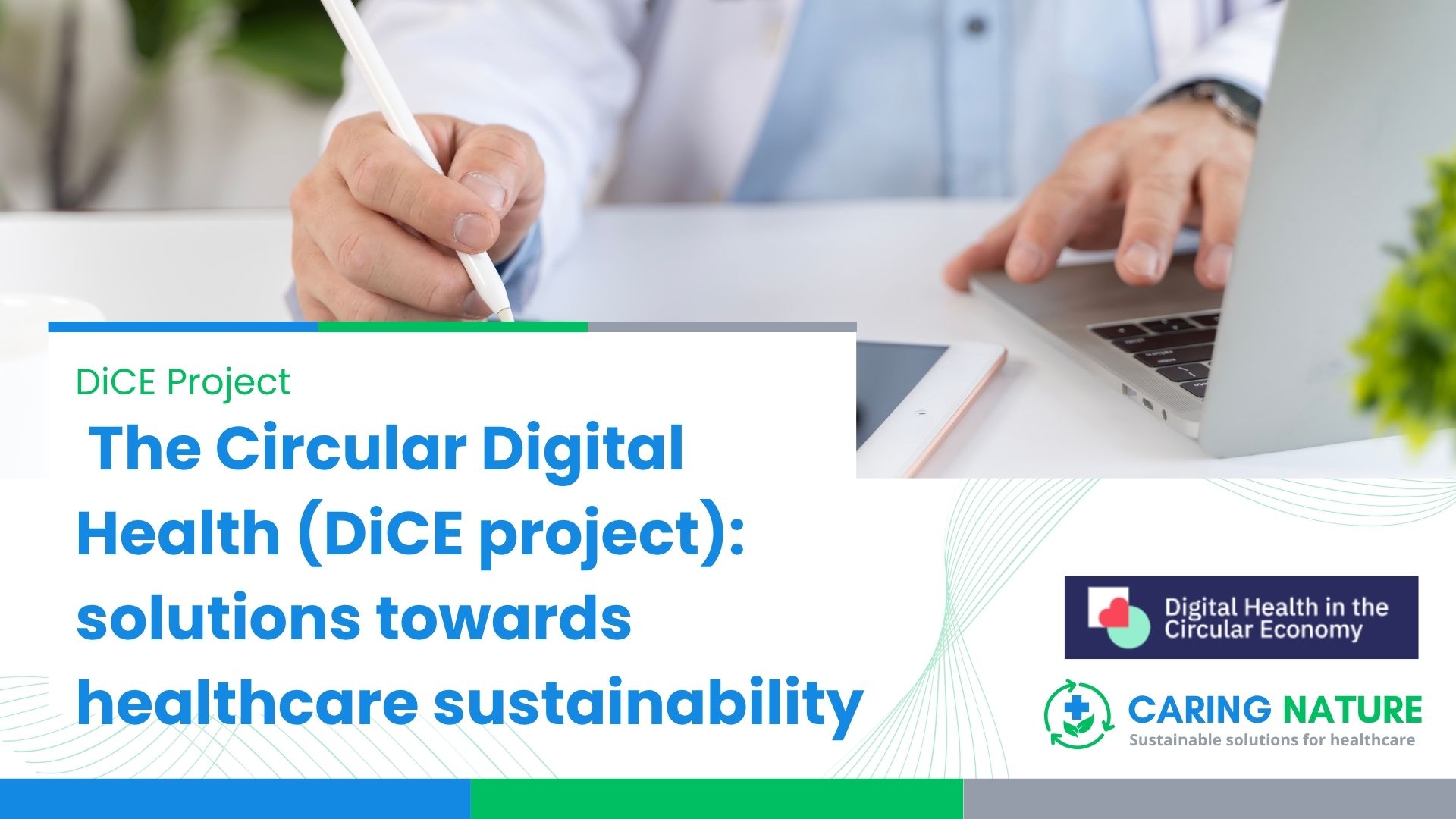
After extensive research, real-world pilots and collaboration across the healthcare value chain, the EU-funded DiCE project has published its final report, outlining key findings, practical tools and recommendations to accelerate the transition towards a more circular and sustainable digital healthcare sector.
Rethinking sustainability in digital healthcare
Digital health technologies, from connected medical devices to smart monitoring systems, are transforming healthcare delivery and improving patient care. However, their growing use also brings environmental challenges, including increasing electronic waste, resource consumption and the loss of valuable materials.
Addressing these challenges requires moving beyond the traditional linear model of production, use and disposal towards a circular approach that extends product lifetimes, promotes reuse and refurbishment, and improves material recovery.
Funded by the European Union’s Horizon Europe programme, the DiCE – Digital Health in the Circular Economy project brought together 20 organisations from nine European countries, including manufacturers, researchers, recyclers and other healthcare stakeholders, to develop, assess and test circular solutions for digital health devices.
Key findings from research and real-world pilots
Through lifecycle assessments, circular design studies and practical pilots, DiCE demonstrated that significant environmental improvements are possible without compromising patient safety or clinical performance.
Among the project’s main findings:
- 81–94% reduction in environmental impacts when using reusable ECG lead sets compared with disposable alternatives.
- 414 citizens participated in collection pilots in Belgium, Spain and Slovenia, with over 60% expressing willingness to return unwanted healthcare devices.
- Up to 90% potential material recovery from redesigned powered surgical staplers, compared with 51% under current designs.
- System-level improvements can deliver substantial benefits, demonstrating that environmental performance depends not only on individual devices but also on clinical workflows, logistics and healthcare delivery.
The pilots also highlighted the importance of convenient collection infrastructure, clear instructions and effective reverse logistics systems to encourage patients to return devices and enable the recovery of valuable materials.
From research to action: a roadmap for circular digital healthcare
Building on these findings, DiCE’s final report outlines practical pathways to accelerate the adoption of circular approaches throughout the healthcare value chain.
Key recommendations include integrating circularity into medical device design, facilitating repair, reuse and refurbishment, improving collection and recovery systems, developing economically viable circular business models, and strengthening EU policies and regulatory frameworks.
The report emphasises that improving healthcare sustainability requires coordinated changes across the entire system, rather than focusing exclusively on the materials and environmental footprint of individual devices.
Practical tools to support the transition
To translate its research findings into concrete action, DiCE has developed several resources for policymakers, manufacturers, healthcare providers and other stakeholders.
Circularity Dashboard: supporting evidence-based decisions
The Circularity Dashboard is an interactive decision-support tool designed to help European policymakers and healthcare stakeholders better understand the environmental, economic and circularity performance of digital health technologies.
Drawing on regulatory data, sustainability assessments and stakeholder insights, the dashboard enables users to:
- Assess environmental impacts across different stages of medical device lifecycles and identify opportunities for improvement.
- Evaluate economic performance by comparing lifecycle costs and potential savings associated with reuse and reprocessing.
- Explore circularity trends across Europe, visualising geographical differences in device reprocessing and identifying opportunities for collaboration.
The tool also supports the exploration of alternative scenarios to inform policy development, investment decisions and circular business strategies.
Circular Design Guide: integrating circularity into medical device development
DiCE has also published Heal Without Harm – Design Circular Medical Devices, a practical guide supporting manufacturers, designers and engineers in integrating circular economy principles into medical device development.
The guide presents a five-phase methodology – Define, Question, Circulate, Embody and Evaluate – helping developers identify environmental hotspots, rethink design choices, select circular strategies, extend product lifetimes and assess sustainability performance.
Through practical exercises, design frameworks and real-world examples, it provides actionable guidance on developing more sustainable medical devices while maintaining clinical quality, patient safety and regulatory compliance.
Training materials and educational resources
To facilitate knowledge transfer and uptake, DiCE has developed a collection of training materials covering sustainability assessments, circular design, behavioural approaches to device returns, and safe collection and recovery.
These resources include guidelines, webinar recordings, presentations and educational tools tailored to manufacturers, healthcare professionals, policymakers and waste management actors.
Explore the resources: https://circulardigitalhealth.eu/files
Looking ahead: towards a circular healthcare system
The DiCE project demonstrates that transitioning towards sustainable digital healthcare is both necessary and achievable. Its research highlights the potential of circular solutions to reduce electronic waste, preserve valuable resources and improve environmental performance across healthcare systems.
However, achieving this transition requires collaboration between manufacturers, healthcare providers, policymakers, recyclers and patients, supported by practical solutions, viable economic models and appropriate regulatory frameworks.
By combining scientific evidence, real-world experimentation and actionable tools, DiCE provides a roadmap to help turn circular healthcare ambitions into practice, paving the way for a more resource-efficient and sustainable digital healthcare sector.
Discover the project’s final report, recommendations and resources: https://circulardigitalhealth.eu/
The DiCE project was funded by the European Union under the Horizon Europe Research and Innovation Programme.




 This project has received funding from the European Union’s Horizon Europe research and innovation action programme under the grant agreement n°101137340.